
Blog · November 21, 2024
Rage Displacement Direction
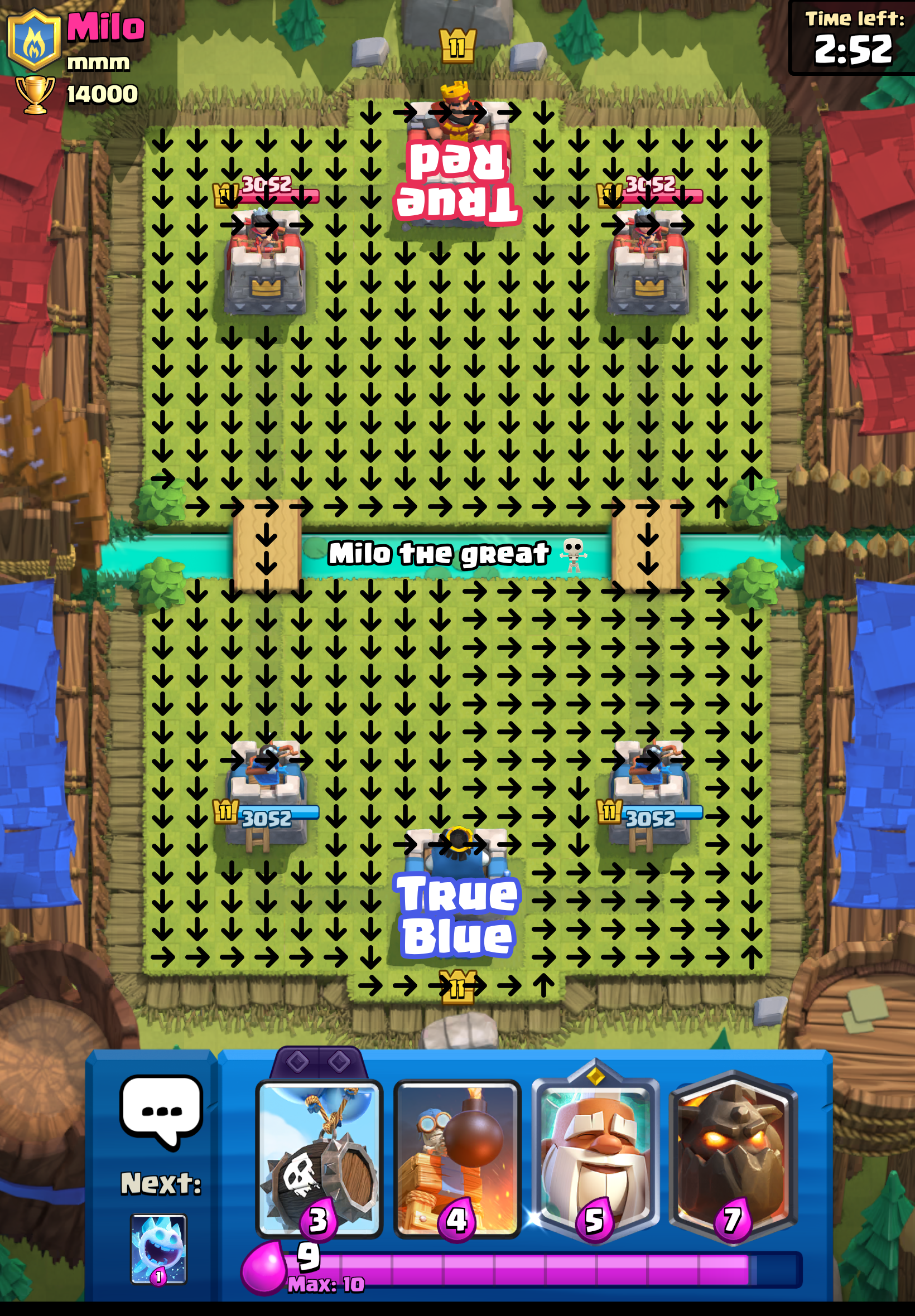
Drop a card on an obstructed tile and the game quietly slides it onto a neighbor. Here is the direction for every tile on the board.
Made by Milo the great · from my video Rage Displacement Direction, which has passed 5M views across platforms
The invisible building
When a Giant Skeleton, Cannon Cart, Skeleton Barrel or Lumberjack dies, the thing it leaves behind — the bomb, the cannon, the barrel, the Rage bottle — is technically a building for a moment. Buildings obstruct placement. And ever since Rage was rebalanced, a lone Rage spell leaves the same invisible building on the tile it lands on.
Here is the part almost nobody knows: if a card is placed onto an obstructed tile, the game does not refuse the placement. It quietly slides it onto a neighboring tile — and which neighbor is not random. Every tile on the board has a fixed displacement direction baked into it. The map above is all of them.
How to read it
Find the tile a card is about to be placed on. The arrow is where that placement ends up while the tile is obstructed. Tiles with no arrow are places a card cannot normally be placed anyway: the river (bridges aside), the tower footprints, and the four bushes by the banks.
One catch: the board you see is not always the board the game sees. The directions live in the game’s own coordinates, so they depend on your True Red / True Blue position. If you are True Blue, read the map exactly as shown. If you are True Red, your whole world is flipped — rotate the map 180°, which is why its name is written upside down at the top. Not sure which you are? The arena clouds will tell you without playing a card.
You have 0.6 seconds
The Rage bottle does not obstruct for the spell’s whole duration — the window is about 0.6 seconds from the moment it lands. Inside that window, anything dropped on the tile slides in the arrow’s direction. After it, placements land normally. So this is not a passive map effect you can sit on: it is a timing play, closer to a parry than a trap.
How the map was made
The same way as my other tile maps: one tile at a time. Place a Rage, drop a card onto the exact same tile inside the window, record which neighbor it slides to, repeat across the board. The displaced placement moves a full tile, so each test reads cleanly — the slow part is simply that there are nearly five hundred placeable tiles, and the odd ones deserve re-tests.
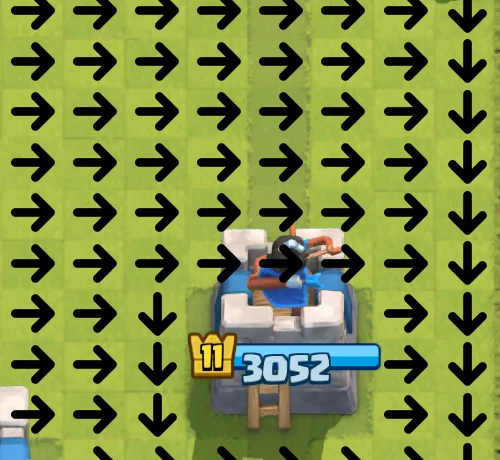
The oddities are real, not testing noise. The top half drains toward the river, but the last land row before it hands everything sideways, ending in a pair of up-turns by the right bank. The bottom half splits in two: the left side flows down toward the back while the right side flows toward the edge. And a few single tiles do their own thing entirely, like the lone down-channel squeezed against the right princess tower.
What it is for
Denying a placement. The classic use is the hail-mary: your win condition is almost at the tower, you know exactly which tile their counter building wants to be on — Rage it. For the next 0.6 seconds their building cannot land there, and the map tells you exactly which tile it gets shoved onto, which is often enough to change the pull.
Placing with the slide. The displacement works for you too. If you are dropping a card into a cluttered push and its tile is obstructed, the map says where it will really land — so you can aim one tile against the arrow and have the game slide it onto the tile you actually wanted.
Every obstruction, not just Rage. The directions belong to the tiles, not to the spell. A Giant Skeleton bomb, a dropped barrel or a dying Cannon Cart obstructs by the same rules, so the map applies any time one of those is sitting where somebody wants to build.
I first showed the obstruction trick in a short clip in early 2023; this map is the follow-through on the promise that the directions could be pinned down, every tile, both halves of the board.